
From the ‘Flamingo Revolution’ to the clashes in the streets of Tirana - we bring you an overview of the decentralized youth rebellion against the government of Edi Rama.
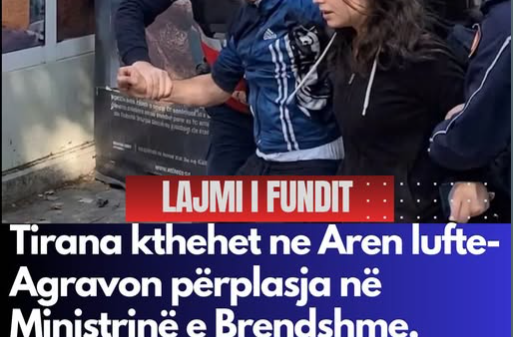
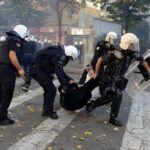
The streets of Tirana have been the scene of clashes between protesters and the police for days, with heavy use of tear gas and police cordons. What started as a series of environmental and student protests has quickly turned into one of the most serious political challenges Prime Minister Edi Rama has faced in more than a decade in power.
As the situation reaches a boiling point, key questions are being asked: who is behind the movement and can it bring about significant political change
Horizontal rebellion and social media
Contrary to government claims that the protests are being led by political opponents or outside actors, journalists and analysts following events in Albania say it is a largely decentralized youth-led movement.
Fatos Hakorja, editor-in-chief of Klan TV and Klan News, told Al Jazeera that the protests have gradually grown into a wider gathering of high school students, university students, environmental activists and disaffected citizens.
“At the moment, it can be safely said that the protests were mainly organized by the youth themselves. What started as the ‘Flamingo Revolution’ gradually developed into a wider student and youth protest... There is no clear evidence that there is a unified structure behind the protests,” said Hakorja.
According to him, coordination is taking place mainly through WhatsApp, Telegram, Snapchat and other social media, rather than through a formal organizational hierarchy. The opposition has supported the protests politically and its supporters are participating on the ground, but so far there is no indication that the opposition parties are directly running their organization.
Albanian political analyst and publicist Ben Andoni describes the situation as a rebellion, not a protest in the usual sense of the word.
“In the last seven days, the protest has turned into a rebellion. It was a protest before, but it never took on the character of a movement. If it had, it would have had a leadership circle of people and short-term, medium-term and long-term goals. It is a horizontal movement in which people are mobilized by TikTok groups and social networks, and not by real cultural and political organizations,” says Andoni.
Such a structure, he adds, is both a weakness of the movement and a problem for the authorities, who do not have a clear interlocutor to negotiate with.
From the ‘Flamingo Revolution’ to wider discontent
The causes of the current protests are manifold: from local disputes and environmental issues to long-term dissatisfaction with the way the country is governed, corruption and a lack of perspective.
The initial spark, dubbed the “Flamingo Revolution”, was resistance to controversial luxury construction projects, particularly in the Zvrnec area and a planned tourist project on the island of Sazan, which were supported by the company of Jared Kushner, the son-in-law of US President Donald Trump. The flamingo, a bird characteristic of the coastal lagoons there, has become a symbol of resistance to what protesters see as the conversion of public space to private interest.
Environmental demands were quickly joined by student anger over high tuition fees, poor conditions in student dormitories and insufficient competitiveness in education. Beneath these immediate causes, Al Jazeera interlocutors see a deeper structural crisis.
“Corruption, nepotism and lack of perspective are the main reasons that led people to protest. Students and youth, who are becoming the engine of this movement, are also adding issues of study conditions and tuition fees, while activists had previously raised environmental issues,” says Andoni.
“The protest summed up a whole range of problems that Albania has and brought them to the government, which, when it comes to corruption, inequality and especially the lack of empathy for citizens, has crossed the line,” he adds.
Hakorja says that among some protesters, especially on social media, there are claims that Rama is subordinating the interests of the state to private interests, his stay in power or foreign interests, including Israeli ones. These claims have not been proven, but, he says, they have further intensified resentment among some young people and the general public.
Rejection of the entire political class
One of the characteristics of the protests is the open rejection of both the ruling Socialist Party and the traditional opposition, including Sali Berisha's Democratic Party.
Although Rama accused the opposition of being behind the protests, and opposition supporters are taking part in the rallies, Al Jazeera's interlocutors stress that opposition leaders have no direct control over the demonstrators. Some opposition MPs who tried to address the crowd were met with open rejection.
“A large number of these young people seem to think that the entire political class does not represent them. They see the political system as a system disconnected from their reality, which protects the interests of a minority more than it solves the problems of the majority of citizens,” says Hakorja.
The main demand of the protesters remains the resignation of Rama and his government. Protesters, the opposition and other interest groups are also calling for the formation of an interim government. At the same time, some students are pushing for better conditions in dormitories and schools, lower tuition fees and a more competitive education system.
The government has publicly signaled its readiness for dialogue, but the protest has no formal leadership or official representatives to negotiate with. Protesters, on the other hand, show little interest in talks, claiming they have lost faith in the current government's ability to bring about change.
The government's response: a security approach and growing fatigue
Faced with a movement without discernible leadership and a willingness to negotiate, the Albanian government is increasingly relying on security forces to maintain control.
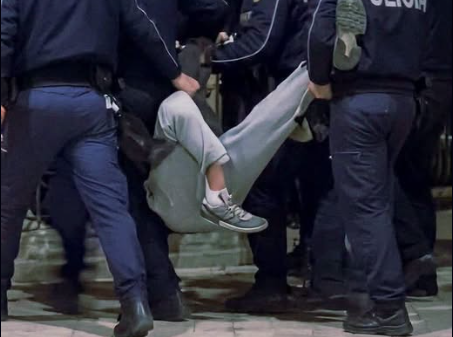
Police forces used large amounts of tear gas, water cannons and rubber bullets, and mass arrests of young protesters followed. In a move that clearly shows the government's support for law enforcement, Prime Minister Rama announced a €2,500 bonus for frontline police officers, with significant salary increases planned for 2027.
Hakorja also warns of an episode that raised additional questions: at the headquarters of the Socialist Party in Tirana, at the time when protesters attacked the building, civilians appeared with wooden sticks, among whom were identified people in public positions. This raised fears that the escalation could lead to informal responses outside regular police procedures.
What comes next
Future developments are uncertain. Without a clear leadership to negotiate and without a solution acceptable to the protesters, the stalemate threatens to prolong political instability.
Andoni estimates that Rama's government has lost moral authority and legitimacy, and that force has become its main instrument of action.
“The demonstrators are persistent and aggressive, while Rama plays with force through the police. However, fatigue affects the youth more. It seems that the police are also tired of the constant pressure of the youth,” says Andoni.
In his estimation, the youngsters may be the first to make a tactical retreat, leaving the onus on Rama to show if he can offer a solution. It remains to be seen if this youth rebellion will mark the beginning of a new political era in Albania or if it will die down under the pressure and fatigue of the police. However, this clearly shows the deep gap between the youth and the ruling political establishment.
Source: Al Jazeera