Edi Rama has destroyed democracy within his party, marginalized the opposition and put the media under control, which has led to massive corruption, Mark Marku, dean of the Faculty of History and Philology at the University of Tirana, tells Al Jazeera.
The student protests in Albania represent a turning point that has severely shaken the government of Prime Minister Edi Rama and reopened the issue of the country's future after decades of transition.
Mark Marku, dean of the Faculty of History and Philology at the University of Tirana, in an interview with Al Jazeera talks about the causes of the growing dissatisfaction of citizens, the paradox of economic development accompanied by growing poverty and mass emigration, and warns that Rama's resignation in itself will not bring fundamental changes without abandoning the authoritarian model of governance.
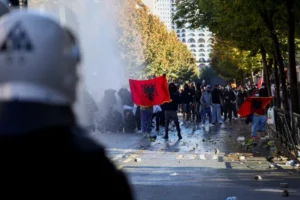
- This protest represents a turning point in the political development of Albania. For the first time since June of this year, when the “Flamingo” protest broke out as a peaceful civil protest with massive participation, we are facing an uprising against the government of Edi Rama. Unlike the previous protests, this uprising is taking dramatic proportions precisely because of the violent confrontation between the security forces on one side and the demonstrators on the other.
The fact that this new protest was initiated by university students, who were later joined by high school students and other citizens, has put Prime Minister Edi Rama in a difficult position and put him under great pressure. This has called into question his way of governing and the continuation of his rule in the eyes of Albanian society. Until this protest, his rule seemed strong; it is now seriously threatened.
- I believe that the reasons why people rose up against Rama's government go very deep and in some cases even precede his coming to power.
If we as a society really want fundamental change, we must not deal mechanically or superficially with the consequences of problematic governance without confronting their causes.
A serious analysis of what has happened in Albania since the fall of communism, and especially since Prime Minister Rama came to power, reveals a real paradox. The country has undergone extremely rapid economic, social and political change – often chaotic, but undoubtedly profound. According to statistics, economic growth has been and remains stable, the state budget has almost tripled, and major investments have been made in road infrastructure, tourism and the energy sector. However, poverty has increased.
The country is filling up with tourists attracted by these investments and its wonderful natural resources, while Albanians, especially young people, are leaving. We have overused natural resources, while at the same time we are losing human resources to the extent that today more Albanians live abroad as immigrants than in the country itself. Economic development has not translated into social welfare for the majority of citizens; on the contrary, for some it has meant even greater poverty. This is exactly what lies behind the student and civic rebellion.
I believe that this paradox can be explained by the model of governance that has been offered to us over the years. Certain groups with neo-Marxist views, who participate in the protests, are trying to channel this discontent into a critique of the capitalist system. In my opinion, these problems stem from the governance model and should be analyzed as such. This is why we need to change the model that has been applied so far in Albania – a hybrid model that should evolve into a normal democratic model. This, of course, cannot be achieved immediately or easily.
Although Albania officially overthrew the totalitarian regime in 1990, the political forces and their leaders, elected almost regularly in semi-rigged and semi-democratic elections, attempted, after coming to power, to concentrate all power in their hands – that is, in the hands of the leader.
Rama did exactly the same during his thirteen years in power. First, he destroyed democracy within his own party, the Socialist Party. Then he marginalized the opposition, making it dysfunctional, and with it the parliament. He also brought the media under his control, replacing informing citizens with constant propaganda. In doing so, he created a pyramidal state structure designed to maintain the power and authority of the leader, regardless of the needs of the Albanian citizens.
It is this model that has led to massive corruption, the destruction of the market economy through the clientelistic distribution of public money, the connection of state structures with organized crime, the distortion of the will of the voters and, as a result, the lack of democratic representation of citizens in the public life of the country.
The consequences of this form of government are numerous and cannot be resolved simply by replacing the prime minister, who, of course, bears the greatest responsibility for this state of affairs. If we only replace authoritarian leaders and do not create conditions that will prevent us from fighting again against a new authoritarian leader, we will achieve nothing.
That's why I say that Rama's resignation in itself would not solve the problems of Albanian society. It would be only one step towards their solution.
How will we be able to assess whether the student protests in Albania were successful?
- The protest immediately left a strong impression on the Albanian and international public. That in itself is a success.
The main and only goal of the protesters is the resignation of Prime Minister Rama, and thus they have set the criterion for success. So far, Rama and his government have shown no willingness to respond positively to this request.
Personally, I would judge the success of the protests not only by the achievement of this goal, but also by the fact that the protesters manage to build a social consensus for a change in the way the country is governed - a process that can naturally culminate in the achievement of their only goal: the resignation of Rama.
For now, I believe the greatest success of the protests is that they have transformed civil discontent into civil political action, and that is no small feat.
Can your decision, as the Dean of the Faculty of History and Philology, not to register student absences from classes be seen as an act of support for the protesting students?
– The decision not to register student absences supports the basic rights that not only students, but all citizens of a democratic society should enjoy: the right to protest and the right to choose.
In many cases, some teaching staff in Albanian educational institutions have used their authority over students to limit their social and political reactions, exerting pressure by sanctioning absences. I have never agreed to such a practice and I never will agree to it.
The decision was made to ensure equal treatment for those who want to participate in the protest and those who do not. At the same time, we have maintained the possibility for students who want to attend classes to continue their studies. I believe that this has helped to avoid conflicts between students and for each group to make the decision they consider right, in accordance with their beliefs.
Throughout history, universities have often been places where change begins. However, until the recent student protests in Albania and Serbia, this seemed to be relatively rare in the Balkans. How do you explain this lack of initiative?
– I think it is related to the tradition of eastern communist countries, where schools and universities have long served as an extension of totalitarian regimes. They have fostered total obedience to authority, rather than a democratic culture of freedom of expression, choice and civic action.
However, in Albania, it was precisely the student protests of the 1990s that brought down the communist regime. Therefore, the students had a significant impact on the modern history of Albania. Today, after 36 years of democracy, it seems that they are trying to exert such influence again.
It remains to be seen if they will succeed. If they succeed, it will mark the end of a long chapter of transition from a totalitarian communist country to a post-communist democratic state and the beginning of a new chapter - of Albania as a normal democratic country.
Some demonstrators in Tirana have used violence. Do you worry that such actions could damage the credibility of the protests?
- The violent actions of the demonstrators on the one hand and the equally violent reaction of the law enforcement forces on the other hand have evoked both hope and fear among Albanian citizens. If neither side shows willingness to withdraw, there is a risk that the country will slide into chaos or civil conflict.
This risk is further increased by the fact that, apart from ordinary citizens, various groups have joined the protest, which see violence as the only means to impose politics on Albanian society.
If violence continues to escalate, the role of students as a peaceful force of resistance within the protests will weaken and broad public support will decrease. This would make it much more difficult to create a democratic climate for changes that would improve both democratic standards in the country and the quality of governance.
Source: Al Jazeera