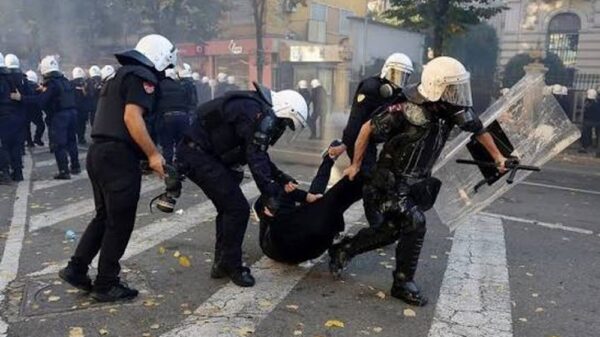
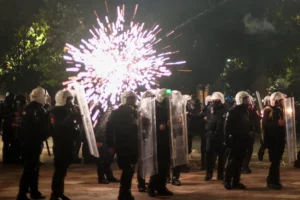
Protesters shoot fireworks at riot police in front of the National History Museum during anti-government protests in Tirana, Albania, October 20, 2026. [Florion Goga/Reuters] Anti-government protests in Albania continue unabated, with police using water cannons again on Tuesday to quell the unrest, footage released by Reuters showed.
Thousands of protesters have taken to the streets of Tirana to demand the resignation of Prime Minister Edi Rama. They also gathered outside the prime minister's office on Tuesday, throwing Molotov cocktails.
Citing police sources, local media reported that a total of 300 people, ranging from minors to those over 50, were arrested during the first seven days of the protests.
The protests have been marked by arson and destruction of public and private property, as well as attacks on the police with stones, Molotov cocktails and other strong objects.
The police in Tirana said that 51 of those arrested had criminal records, the website Shqiptarja.com reported.
Protesters destroyed or damaged several government buildings, including the Supreme Court, which announced the postponement of court hearings except in urgent cases, the website of Albania's public service Radio Television reported.
On the other hand, protesters reported excessive use of force. Two journalists and several protesters reported being hit by rubber bullets.
Their bodies were marked.
The Police Director, Skender Hita, did not deny their use.
Albania's ombudsman has launched an investigation and the OSCE has called for an independent investigation into all reported cases of illegal use of force.
Rama is under serious threat
Mark Marku, dean of the Faculty of History and Philology at the University of Tirana, told Al Jazeera that these protests represent a turning point in Albania's political development.
“The fact that this new protest was initiated by university students, who were later joined by high school students and other citizens, has put Prime Minister Edi Rama in a difficult position and exposed him to strong pressure. This has called into question his way of governing and his survival in power in the eyes of Albanian society,” Marku said.
“Until these protests, his rule seemed strong, but now it is seriously threatened,” he added.
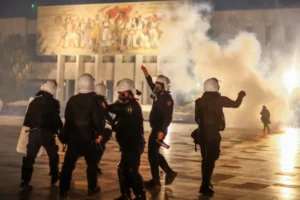
Police officers in special equipment stand outside the National History Museum during an anti-government protest by students in Tirana, Albania, October 20, 2026. [Florion Goga/Reuters]
The protests, which began in late May as resistance to a luxury tourism project on the Adriatic coast linked to Jared Kushner, the son-in-law of US President Donald Trump, have turned into an anti-government movement that has lasted several months.
In October, demands for coastal protection in Tirana were linked to student dissatisfaction with the cost of education, corruption and the government's attitude towards citizens' demands.
Prime Minister Edi Rama, who has been in power since 2013 and won a fourth term in the 2025 elections, has dismissed calls for his resignation. On Tuesday, he called on students to engage in dialogue. In a symbolic act, chairs with placards reading “Dialogue” were placed outside the prime minister's office, a sign of the government's willingness to sit down and talk to the protesters. The protesters broke the chairs.