

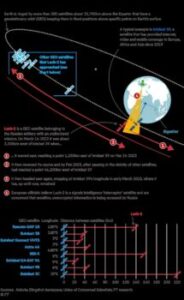
Security officials in Europe have raised the alarm after two Russian spacecraft allegedly intercepted the communications of at least 12 critical European satellites, potentially exposing sensitive data and raising fears of interference or sabotage in space. The information was reported by the Financial Times, citing Western intelligence sources. According to the same sources, the activities of the two Russian orbiting vehicles, known as Luch-1 and Luch-2, have intensified over the past three years, in a period of high tensions between Russia and the West following the invasion of Ukraine. Western military and civilian authorities have monitored repeated and suspicious maneuvers of these satellites near European space infrastructure.
The two Russian vehicles came dangerously close to some of Europe's most important geostationary satellites, which are located about 35,000 kilometers above Earth and are used for civil, government and partly military communications in Europe, the United Kingdom, Africa and the Middle East. Orbital data and observations from ground-based telescopes show that Russian satellites have been near them for weeks or months. Since its launch in 2023, Luch-2 has approached at least 17 European satellites.
The head of the German armed forces' space command, Lt. Gen. Michael Traut, told the Financial Times that the two Russian satellites are suspected of conducting signals intelligence (SIGINT) operations, positioning themselves too close to Western satellites to intercept their transmissions. According to a senior European intelligence official, the Luch vehicles are designed to stay within the narrow range of signals transmitted from ground stations to satellites. The main concern is related to the fact that many European satellites, built years ago, still transmit command data without advanced encryption. This, experts say, makes them vulnerable to interception and possible future interference, including orbit manipulation or decommissioning.
Western officials see the activity as part of Russia's broader “hybrid warfare” strategy, which also includes infrastructure sabotage, such as damaging undersea Internet and power cables. The fear is that space is becoming a new front of geopolitical confrontation. The German Minister of Defense, Boris Pistorius, warned earlier that “satellite networks are the Achilles” heel of modern societies", stressing that any attack on them can paralyze entire countries. He described Russian activities as a serious threat to European security, especially in space. According to analysts, even if Russian satellites have no direct ability to destroy targets, the information gathered could allow Moscow to understand the weaknesses of Western systems and coordinate future cyber or electronic attacks from the ground or orbit.