NATO Supreme Allied Commander Europe,
American General Alexus Grynkewich has stated that the Alliance is prepared to cope
any attack on member countries. The American general emphasized that the war is not even imminent
and not even inevitable, but warned that NATO will fight if someone attacks its territory...
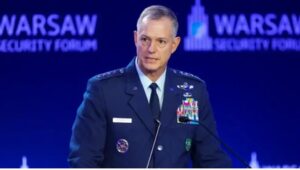
The supreme commander of NATO's Allied Forces in Europe, American General Alexus Grynkewich, has given a direct message about the Alliance's readiness for war, warning that any attack on one of the member countries will be met with a military response.
Speaking at the Warsaw Security Forum, Grynkewich stated that he does not believe a military conflict is imminent or inevitable. However, according to the BBC, he emphasized that NATO must maintain its readiness to fight, as only continuous military preparation can serve as a deterrent.
“If someone is reckless enough to attack us, we will fight,” declared the American general.
Grynkewich explained that NATO aims to stop an attack at the initial stage, before opposing forces reach their objectives. If the aggressor continues military operations, the Alliance will use its capabilities to weaken the attacking forces and impede their progress.
This strategy does not rely only on the protection of the borders of the member countries. It also envisages countermeasures against military capabilities that support an offensive, including logistics and command structures, according to previous reports on the plan the US general has presented.
Essentially, NATO seeks to avoid a scenario where an adversary manages to seize territory and then uses it to impose political or military conditions. For this reason, Grynkewich placed emphasis on the ability to stop the initial attack and prevent its continuation.
The statements of the American commander take on special importance in the framework of NATO's security policy towards Russia. In the Strategic Concept of 2022, the Alliance identified Russia as the most important and direct threat to the security of member countries, following the large-scale invasion of Ukraine.
However, Grynkewich's declaration of a military response does not constitute an announcement of an imminent war, nor a decision to launch operations against Russia. The general presented military readiness as a condition to prevent a conflict.
In this context, Article 5 of the North Atlantic Treaty is also important, which stipulates that an armed attack against one or several member countries is considered an attack against all. Each ally takes the measures it considers necessary, including the use of armed force, to help the attacked country.
His message in Warsaw defines the line that NATO intends to follow: preventing war through military preparedness and responding if an adversary decides to attack one of its member countries.
What exactly does the NATO plan envisage?
According to Reuters, Grynkewich summarized the Alliance's strategy in three actions: blocking the attack, weakening the opposing forces and striking the military system that supports the aggression.
He declared that NATO will stop the attack and will deny the aggressor the opportunity to achieve the objectives, whatever they may be. The general added that the Alliance aims to make any attack against a member country completely unsuccessful.
If the adversary decides to continue the offensive or commit reserves, NATO will strike not only the units directly participating in the attack, but also the system that supplies, supports and commands them. This means that the response will not necessarily be limited to the area where the aggression started.
The Polish newspaper Rzeczpospolita reported that the strategy envisages stopping a ground attack, securing air and sea superiority and, if the offensive continues, striking the adversary's logistics infrastructure and command centers.
The American general also clarified that NATO does not seek a strategic victory through nuclear escalation. He presented the plan as a strategy to defeat forces attacking the Alliance, not to launch a nuclear war against Russia.
In an interview with TVP World, before the forum, Grynkewich also spoke about the possibility of a Russian attack on Poland or the Baltic countries. He stated that NATO is ready to react immediately, but aims to identify and prevent the threat before it materializes.
According to him, prevention relies on the demonstration of the strength and unity of the member countries. In this way, the Alliance aims to convince the adversary that an attack would not bring military benefits.
Grynkewich's statements come as European governments accuse Moscow of increasing sabotage, drone intrusions and cyber attacks. Reuters also reported that Russia had warned of using nuclear weapons if NATO tried to blockade the Russian enclave of Kaliningrad.
Although the general did not mention Russia by name during his warning, the strategy he presented in Warsaw is directly related to the defense of NATO's eastern flank and the scenarios of a military aggression against member countries.
The supreme commander's message was that NATO does not seek conflict, but will use its military capabilities to stop an attack, destroy the aggressor's ability to continue it, and defend Alliance territory. /Pamphlet/