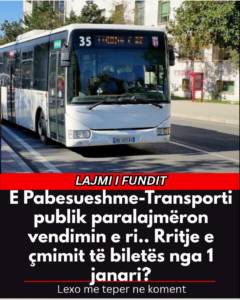
From January 1, if the government will not apply VAT reduced to 6% also for public transport, the operators warn that they will start asking for an increase in the price of tickets and subscriptions.
About 500,000 citizens per day who use public transport are expected to be affected by the change in prices nationwide.
The National Association of City Transport in a letter addressed to the Commission for Economy, Employment and Finance, the Ministry of Finance and the Ministry of Infrastructure requests consideration of its request for the inclusion of public transport in the VAT scheme reduced to the amount of 6%. With the new fiscal package, only a list of 54 food products will be included in this scheme.
The association estimates that their proposal should be taken into consideration, since the increase of the general VAT from 20% to 21%, as a measure, will exert pressure on both ticket and subscription price increases.
The proposed increase in the standard VAT rate from 20% to 21% should be evaluated in relation to the budget effect and the possible economic and social consequences for public transport users and operators, as operators cannot unilaterally increase the price, as the price is determined by the local government. “Operators have neither the right nor the opportunity to unilaterally increase the price of a ticket or subscription, even in cases where they are faced with:
Increase in the price of fuel and energy.
Increase in salaries and contributions for personnel.
Increase in costs of maintenance, spare parts and vehicle insurance.
Fleet renewal and modernization costs.
Obligations for the realization of kilometers, frequencies and approved service schedules.
In this situation, an economic disparity is created between the obligations that the operators must fulfill and the opportunities they have for ensuring income. The increase in costs cannot be automatically reflected in the ticket price, while the operators' income remains limited by the approved tariffs. Consequently, any additional fiscal burden, without a corresponding relief or compensation mechanism, risks deepening the negative financial result, reducing investment capacity and jeopardizing service continuity. The association estimates that it is not economically sustainable for the state, on the one hand, to administer the price of the service and, on the other hand, to increase fiscal obligations without providing a mechanism that guarantees the coverage of the real costs of its provision.
Meanwhile, the National Association of City Transport argues that in some countries of the European Union, reduced VAT is applied to this sector, including countries of the Western Balkans and the European Union.
Full letter from the National Transportation Association
The National Association of City Transport, representing the interests of licensed operators of public passenger transport, within the framework of the parliamentary procedures for the review and approval of the State Budget Project and the Fiscal Package for 2027, presents for review a series of requests and proposals that are directly related to the economic sustainability of the sector, the fiscal burden of exercising the activity and guaranteeing an affordable public service for citizens.
We estimate that fiscal policies for the year 2027 should take into consideration the special nature of public transport, which, unlike ordinary commercial activities, operates on regulated tariffs, defined obligations for the service and legal and administrative restrictions on the adjustment of prices to real costs.
Public transport does not simply represent an economic activity, but is a service of general public interest, directly related to the movement of citizens, access to employment, education, health and participation in economic and social life. It is one of the main arteries of the city's life.
For this reason, the Association requests that public transport be treated, from a fiscal point of view, in a manner similar to the basic products and services of the family basket and submits the following demands:
Disapproval of the proposed VAT increase in 21% and the reduction of the VAT rate for public transport in 6%.
According to the 2027 Fiscal Package presented by the Government, it is proposed to increase the standard VAT rate from 20% to 21%. In the absence of a reduced rate for public transport, this measure could put pressure on the price of the daily ticket and the monthly subscription, affecting citizens, students, pensioners and the needy.
Taking into account the increase in fuel costs and living expenses, the Association assesses that any additional increase in the fiscal burden on public transport should be analyzed in relation to the impact on citizens and the financial capacity of operators.
The association positively evaluates the principle of protection of basic family consumption, but considers that this treatment should also be extended to the public transport service of passengers. Public transport is a necessary and periodic expense in the family budget.
For many citizens, using the bus is not a consumption choice, but the only economically affordable way to go to work, school, health institutions or to meet daily needs. According to the Association's preliminary assessment, the public transport service includes a significant population of users, estimated at around 450,000–500,000 citizens nationwide.
A significant part of these users belong to low and middle income families, students, pensioners and people for whom owning or using a private vehicle is economically unaffordable. For these reasons, public transport should be considered a functional part of the basic household consumption basket and benefit from reduced fiscal treatment.
Within the European integration process, the Association proposes to consider the fiscal practices of European countries that apply reduced rates for passenger transport, such as Portugal, Germany, Austria, Italy and Spain. Rates vary by state and type of service; there is no single rate of 6% for all countries of the European Union.