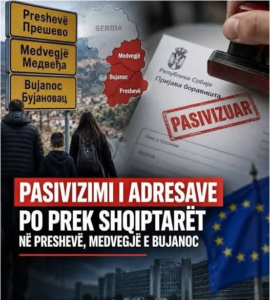
DEACTIVATION OF ADDRESSES IN THE PROVINCE OF PRESHEVA, MEDVEGJA AND BUJANOC
Research on the administrative, demographic, political and discriminatory effects on ethnic and autochthonous Albanians in Serbia
The deactivation, erasure or suspension of residential addresses of Albanian citizens in the Province of Preševo, Medvejja and Bujanovac has become a very serious issue of fundamental human rights, collective rights, the rule of law and the democratic functioning of institutions.
This practice should not be seen only as a technical or administrative issue, when its implementation particularly affects the ethnic and autochthonous Albanians, who have faced and continue to face many difficulties. We are now in the process of challenging administrative decisions on passivation, so there is a legitimate concern about discrimination and the violation of the effective exercise of the fundamental and collective rights of Albanians in Serbia.
Passivization as a serious concern for the rights of Albanians
As a result of all this ethnic cleansing - or, more precisely, the discrimination that is called passivization - based on the research and the Law on residence and residence (“Official Gazette of RS”), no. 87/2011, which continues to be applied in a selective and discriminatory manner, targeting only ethnic Albanians and autochthonous in Serbia, the EU is requested to stop these marginalizing and discriminatory practices and exert pressure for this law to be changed within this legislature of the Parliament of Serbia, since, according to this position, it is contrary to European and international acts and conventions.
This practice should not be understood and treated simply as an administrative procedure for verifying residence. Serbia is implementing passivation unilaterally and disproportionately, or without effective legal challenge. In many cases, passivated persons are not issued with decisions on the passivation of addresses at all.
This produces direct consequences on the possibility of exercising the civil, political, social and economic rights of ethnic and autochthonous Albanian citizens in the Province of Preševo, Bujanovac and Medveja, as well as everywhere in Serbia. Precisely for this reason, the issue of passivation of addresses in this province requires increased attention from European institutions and international mechanisms for the protection of human rights and collective rights.
The passivization of addresses and residence is of great importance in the citizen's relationship with the public administration and in the practical exercise of a number of rights. When a citizen's address is deactivated, serious obstacles may appear in personal documentation, in proof of residence, in exercising the right to vote and in other administrative procedures.
What is the number of passive Albanians?
What is the number of ethnic and autochthonous Albanian citizens in the Province of Preševo, Bujanovac and Medveđa, as well as all over Serbia, whose address has been deactivated, and what is their number in relation to other citizens in Serbia
The number of the disabled is not officially known, as there is a significant lack of transparency and access to an official published statistic.
Based on notes and statistics not exactly verified, it is concluded, supported by some data from the Albanian Association that actively deals with passivation, that every fourth citizen of Serbia belonging to the Albanian nationality from the municipalities of Presheva, Medvegja and Bujanovac is passivated.
Expressed in numbers, it is about over 25 thousand Albanian citizens whose addresses have been deactivated.
When we add to this the ethnic and autochthonous Albanians who live outside these three municipalities, it turns out that the number of citizens of Serbia with Albanian nationality, whose addresses have been deactivated, may be over 50-70 thousand.
According to this position, they have been deleted from the civil registers and have been passive in the administrative sense, losing the possibility of exercising a number of rights.
With the passivation of addresses, as a form of ethnic cleansing through administrative means, the Municipality of Medvegja has been affected the most. According to the data presented, it turns out that 85 percent of Albanians have been passive in the Municipality of Medvegja, while in the Local Municipality of Zarbica and in the Local Municipality of Muhoci, it turns out that over 80 percent of Albanians have been passive in these two local communities, known as Malësia e Bujanoci.
Passivization endangers the proportional and democratic representation of Albanians in Serbia
One of the most worrying aspects is the possible impact of passivation on the political participation of Albanians, to exercise the legal right to vote and to be voted for.
If citizens previously registered in a municipality no longer appear with an active address and this affects the registration or exercise of the right to vote, then the consequences are no longer just individual; they pass and become collective as well. Among the consequences may be:
- Artificial reduction of population;
- Impact on the distribution of resources and public budgets, as well as on budgets and investments;
- Risk of using language and symbols;
- Influence on participation in local elections, in the Albanian National Council and in parliamentary elections;
- Impact on proportional representation in the Police, Court, Prosecutor and local and central institutions;
- The influence on decision-making and the institutional weight of ethnic and autochthonous Albanians.
For this reason, there should be transparency through official and documented statistics on the changes in the number of citizens with an active address and their impact on the electoral and institutional processes.
The issue of property and property rights that are transferred and inherited
The issue of property and inheritance presents high administrative difficulties. It affects personal documentation, proof of residence or access to administrative procedures and can create serious practical problems for citizens in exercising and protecting their inherited and transferable rights.
The passivation of the address must be understood and examined from this perspective as well. Therefore, it is imperative that institutions publish and guarantee that address passivation is not used in order to create unjustified obstacles for citizens in the protection and exercise of their property and inherited rights.
Through administrative silence, Serbia risks the depopulation of Albanians as a form of ethnic cleansing and discrimination
The European Union should understand that the passivation of addresses is producing a tangible effect, in such a way that ethnic and autochthonous Albanian citizens are being quietly and administratively removed from their settlements and localities, even when they continue to have real ties to these settlements.
Such a practice is taking place on a large scale and is mainly affecting and harming the Albanians in Serbia. This raises the necessity to investigate whether we are dealing with a state mechanism that, directly or indirectly, contributes to the demographic, political and institutional weakening of ethnic and autochthonous Albanians.
Therefore, the term “administrative depopulation”, called in the official language “passivization of addresses”, deserves special attention, as it represents a serious concern.
The Albanians of the Presheva, Medvegja and Bujanova regions are demanding the realization of the right to have every administrative procedure implemented in an equal, transparent and non-discriminatory manner.
Based on the claim that every fourth citizen of Serbia belonging to the Albanian nationality from the Province of Preševo, Medveđa and Bujanovac is passivated, or, expressed in numbers, that there are over 25 thousand Albanian citizens whose addresses have been passivated, this number shows the extent of the problem of losing the active status of the address.
As a result of the passivation of addresses, we are facing obstacles in documentation, in political participation or in relations with public institutions. Hence the need for an independent investigation.
It is not enough for a practice to be formally prescribed by law. It must also be in accordance with the principles of equality, proportionality, legal certainty and non-discrimination, which are also applicable within the framework of European standards.
The Council for the Protection of Freedoms and Human Rights and the Albanian National Council have addressed the issue of arbitrariness and non-transparency as a process of passivation of addresses. Based on the collection of names, a register was created and worked on, as a database and approximate statistics, where the names and surnames, as well as relevant notes on the passivated persons, were recorded, based on the will of each one.
The consequences of the passivation of addresses on ethnic Albanian citizens
A citizen who faces the passivation of the address may encounter difficulties in his relations with state institutions. Among the consequences that must be carefully analyzed are:
- Difficulties in providing or updating personal documents;
- Obstacles in proof of residence;
- The influence on the registration in the electoral lists and the exercise of the right to vote;
- Difficulties in administrative and legal procedures;
- Possible impact on access to public and social services;
- Consequences in property relations and in procedures that require proof of residential status and address;
- Inability to exercise rights related to ownership and employment;
- Problems with freedom of movement, etc.
These consequences must be examined on a case-by-case basis and in accordance with applicable legislation.
Since the passivation is disproportionately affecting only ethnic and autochthonous Albanians, as a certain ethnic group, then, according to this position, we are dealing with a much wider discrimination than an administrative procedure.
Serbia bears the responsibility for the passivation of addresses on ethnic Albanian citizens
The passivization of addresses has also influenced the reduction of the representation of Albanians in local institutions, bringing about a significant deterioration of the demographic and social situation in the region. It has created an environment of uncertainty for many Albanian individuals and families, who have been deprived of the opportunity to participate in public and political life.
According to this view, passivation aims to reduce the influence of the Albanian minority in Serbia.
The passivization of addresses is considered a tool that helps achieve the political goals of the Serbian authorities to control and change the ethnic composition of these three municipalities.
The Republic of Serbia must ensure that all administrative procedures are transparent, controllable and apply equally to all citizens, regardless of ethnicity.
Every citizen should have the right:
- To be informed about the reason for the passivation;
- To have access to the administrative decision;
- To have the right to appeal and effective judicial review in all judicial instances;
- To have priority treatment of subjects and equal treatment;
- Ensure that his real residence is taken seriously in administrative proceedings.
Without these guarantees, legal uncertainty is created and citizens' trust in state institutions is weakened.
The European Union is responsible for the passivation of the addresses of ethnic Albanian citizens in Serbia
The European Union should not treat this issue only as an internal administrative problem of Serbia.
Respect for human rights, respect for collective rights, the rule of law, combating arbitrariness and non-transparency in the process of passivation of addresses, non-discrimination and the effective protection of national minorities are part of European standards.
Therefore, the institutions of the European Union should request from the highest Serbian authorities:
- Publication of complete data on the number of deactivated addresses in the Province of Presevo, Medvegja and Bujanovac;
- Transparency on the criteria and procedures used for passivation;
- Analysis of the impact of this practice on ethnic and autochthonous Albanians;
- Ensuring effective legal remedies for affected citizens;
- Independent monitoring of the implementation of this procedure;
- Direct dialogue with representatives of Albanians in the Region of Presheva, Medvegja and Bujanovac.
The region of Presevo, Medveja and Bujanovac is not an internal matter of Serbia, but belongs to Europe
The issue of the ethnic and autochthonous Albanians of Presevo, Medveja and Bujanova should not be seen only through the prism of Serbia's internal politics.
Through this researched process, I take the opportunity to appeal, since the EU now has the basic and necessary information, after it has been alerted and signaled, to take concrete and emergency actions.
A commission charged with the investigation of passivation should be established, these discriminatory practices should be stopped immediately and opportunities for independent and transparent investigations should be provided, ensuring and guaranteeing the presentation of the correct number of people who have been passivated.
No double standards
The European Union cannot have different standards when it comes to the rights of communities. If it requires the respect of the rights of a community in a part of the region, the same principles should be applied to the ethnic and autochthonous Albanians in the Province of Preševo, Medveđa and Bujanovac.
Human rights cannot depend on ethnicity, geographical location or political interests of the moment.
A Europe based on the rule of law must be consistent in protecting the rights of all communities. It is directly related to the European principles of democracy, human rights, protection of minorities and the rule of law.
For this reason, the European Union must show special interest and demand verifiable data, transparency and institutional responsibility.
The deactivation of addresses in the Region of Preševo, Medveđa and Bujanovac, as well as throughout Serbia, should not be treated simply as an administrative procedure. Since its implementation, according to this view, disproportionately affects ethnic and indigenous Albanians, it violates not only the individual rights of citizens - such as the right to political participation and effective access to public services - but also the collective rights of the Albanians of this Province.
This affects political representation, the demographic structure and the equal realization of proportional rights.
For this reason, the passivation must be subject to a full and impartial control of legality, proportionality, transparency, international monitoring and non-discrimination.
We should not be content with political statements. The EU should formally ask Serbia for data and answers on the following issues:
- How many citizens of Serbia, in general, have their addresses deactivated?
- How many citizens of Serbia with Albanian nationality have their addresses deactivated?
- What is the proportion of Albanian citizens in relation to other nationalities in Serbia?
- What is the overview according to residences and localities of citizens whose addresses have been deactivated
- On what criteria are the addresses deactivated?
- How many citizens, according to their nationality, have submitted a complaint to the Ombudsman Institution, have appealed to the Supreme Court, the Constitutional Court or the Strasbourg Court
- How many decisions have been overturned by judicial instances?
What impact has this practice had on electoral lists and proportional representation
And, above all:
Is this practice being applied equally to all citizens, or is it producing a disproportionate effect on the Albanians of Preševo, Medveja and Bujanovac regions?
Thus, Serbia must give responsibility for these actions, all disabled persons must be returned their addresses within this calendar year and be compensated for the damages caused during these years.
Ethnic cleansing through passivation, according to this attitude, constitutes classic discrimination and is changing the ethnic structure. It is presented as a form of legalization of ethnic cleansing and as a violation contrary to international legal provisions.
The Albanians of the Presheva, Medvegja and Bujanovac regions do not ask for privileges; they demand equality before the law, legal security, protection of individual and collective rights and equal treatment with every other citizen.
These are basic standards of a democratic society and of a Europe that claims to respect human rights and collective rights.
Using a research approach, this review argues that Serbia's action produces harmful effects and constitutes, according to the author, a violation of basic human rights and freedoms. Therefore, the conclusion is rightly raised that we are dealing with an ethnic cleansing and systematic discrimination.
The author, Mr.Sc.Refik HASANI, in addition to this review, has also carried out a wider study on the passivation of addresses as a form of ethnic cleansing and discrimination, presented in scientific documents and papers. The overview includes credible references for the topic addressed, which are also the main sources of research on the passivation of addresses for the Albanians of the Presheva, Medvegja and Bujanova regions.
References
[1] Law on residence and location of citizens: “Official Gazette of the Republic of Serbia”, no. 87/2011.
[2] European Court of Human Rights; Universal Declaration of Human Rights; European Convention for the Protection of Fundamental Human Rights and Freedoms and its protocols; International Convention on Civil and Political Rights and its protocols; Framework Convention of the Council of Europe for the Protection of National Minorities; Convention on the Rights of the Child; Convention on the Elimination of All Forms of Racial Discrimination.
[3] Law on State Administration (“Sl. Glasnik R. Srbije”, no. 79/05 and 10/07).
[4] Passivation - source of data and documentation on address passivation.
[5] Law on the Ministries of the Republic of Serbia (“Sl. Glasnik R. Srbije”, no. 16/11).
[6] Law on General Administrative Procedure (“Sl. Glasnik R. Srbije”, no. 18/16).