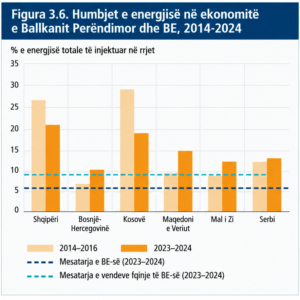
Almost a fifth of the energy entered into the Albanian electricity network does not reach the final consumer, ranking Albania among the countries with the highest energy losses in the Western Balkans. In the period 2023-2024, losses amounted to 19.4% of energy injected into the grid, more than three times the European Union average of 6%. At the same time, the cost of electricity for Albanian businesses is significantly closer to the EU level, creating a contrast between the poor efficiency of the network and relatively competitive prices for non-household consumers.
The data is part of Economic Convergence Report for the Western Balkans 2026, of the OECD which analyzes, among other things, the efficiency of energy infrastructure and energy costs for businesses.
In the Western Balkans, average grid energy losses were 15.2% in 2023-2024, or about 2.5 times higher than the EU average and significantly above the level of 9.2% of neighboring EU countries used by the OECD for comparison. Albania, with 19.4%, stands significantly above the regional average. Only Kosovo has higher losses, with 21.9%, while Bosnia-Herzegovina records the lowest level in the region, 10.4%.
The OECD measures the indicator as the share of energy injected into transmission and distribution networks that does not reach end users. The losses reflect both technical problems, related to outdated infrastructure, as well as non-technical losses, where old measurement systems also play a role.
Albania has, however, made progress compared to a decade ago. Together with Kosovo, it is among the few countries in the region where losses have decreased during the analyzed period. But the improvement has not been enough to change the country's position: Albania and Kosovo continue to have the highest levels of losses in the Western Balkans. Meanwhile, in other economies of the region, losses have increased, while the average of the Western Balkans has remained practically unchanged compared to 2014-2016.
In Albania's profile, the OECD estimates the relative performance for energy losses at 28.4 points against the EU average of 100 in 2023-2024, from 23 points in 2014-2016. So there is improvement, but the gap with the European standard continues to be large.